Attention-Driven Trading Explained and How to Apply
Wednesday, October 07, 2026
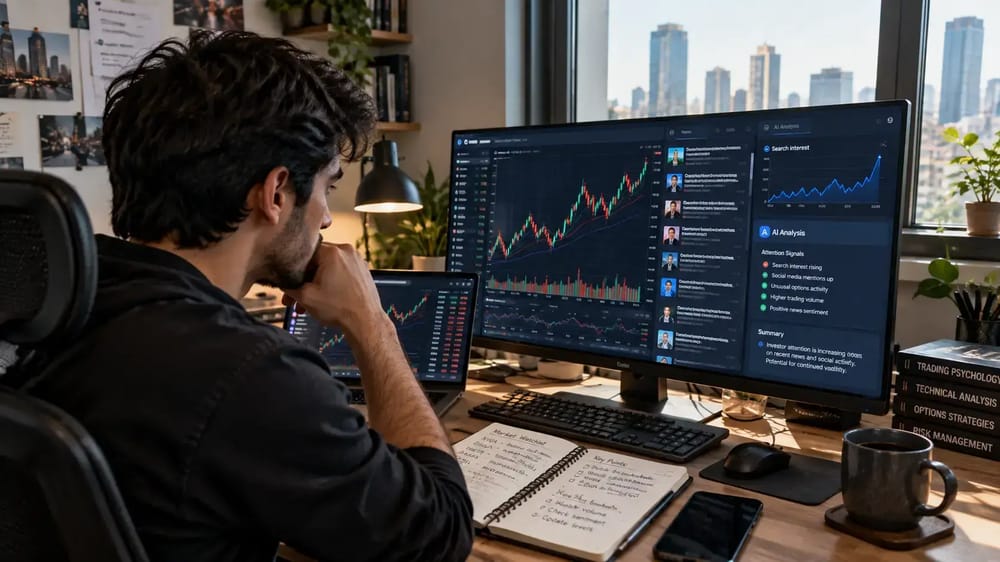
Markets are influenced by more than company fundamentals and price charts. Sometimes, the biggest change is simply where investors are paying attention.
When a stock suddenly starts receiving more searches, news coverage, social media discussion, and trading activity, that increase in attention can provide useful context for traders. Research has found relationships between investor attention, trading volume, and market volatility.
Large call to action headline
Attention-driven trading means considering changes in investor attention when analyzing a stock or market.
For example, imagine a stock that normally receives little attention. Suddenly, the company announces major news and people start searching for it, discussing it online, and trading it more actively.
That creates an attention spike.
The spike itself isn't a buy or sell signal. Instead, it tells traders that something has changed and deserves further investigation.
What Creates Investor Attention?
Several things can cause a stock to suddenly attract attention:
- Breaking company news
- Earnings announcements
- Major price movements
- Analyst upgrades or downgrades
- New products or partnerships
- Regulatory developments
- Social media activity
- Unusual trading volume
Search activity can also be useful. Academic research has used Google search volume as a proxy for investor attention and found that unusual search activity can be associated with higher trading activity.
How to Apply Attention-Driven Trading
A simple approach is to follow five steps.
1. Find an Attention Spike
Look for unusual increases in search interest, news coverage, social discussion, or trading volume.
2. Find the Reason
Don't immediately trade because attention increases. First ask: Why is everyone suddenly watching this stock?
Look for news, earnings, announcements, or a significant price movement.
3. Confirm With Market Data
Check whether the attention is supported by:
- Trading volume
- Price movement
- Volatility
- Momentum
- Recent market activity
This helps separate genuine market activity from temporary online noise.
4. Check the Bigger Picture
Attention shouldn't replace fundamental or technical analysis.
A stock can become extremely popular while still having weak fundamentals. Likewise, negative news can create huge attention without creating a bullish opportunity.
5. Manage the Risk
Attention can disappear quickly. Research has found that the relationship between abnormal search attention and returns can change over time, including longer-term reversals.
That's why attention is better treated as one input in a trading decision, not a guaranteed prediction.
Attention vs. Sentiment
These two concepts are easy to confuse.
Attention asks: "Are people watching this?"
Sentiment asks: "Are people positive or negative about it?"
A stock can have extremely high attention while sentiment is negative. A major controversy, for example, could make a company one of the most discussed stocks in the market.
Understanding both can give traders a clearer picture of what is happening.
How AI Can Help
AI can make attention analysis much easier by processing large amounts of information from different sources.
An AI-powered workflow can help identify:
- Rising search interest
- Increasing news coverage
- Social media activity
- Changes in sentiment
- Unusual trading volume
- Emerging market narratives
Instead of manually checking every source, traders can use AI to surface unusual patterns and then investigate them further. The important part is using AI to support analysis rather than blindly following its conclusions.
Final Takeaway
Attention-driven trading is essentially about understanding what investors are watching and why.
A sudden increase in attention can help traders identify stocks or market events worth investigating. But attention alone doesn't tell you whether a stock will rise or fall.
The strongest approach is to combine attention signals with price action, volume, sentiment, fundamentals, and risk management. In a market overflowing with information, knowing where investor attention is moving can provide another useful lens for understanding market behavior.

Smarter Trading Starts With Clarity
A data-driven approach combining advanced AI, behavioral analytics, and institutional-grade insights to help investors make confident, informed decisions in any market condition.
© Copyright 2025 OVTLYR - All rights reserved.
5830 Granite Pkwy, Suite #100, Plano, TX 75024, USA
Contact now at support@ovtlyr.com