DTE Energy (DTE) Stock Analysis: Data Centers and Market Trends
Monday, October 19, 2026
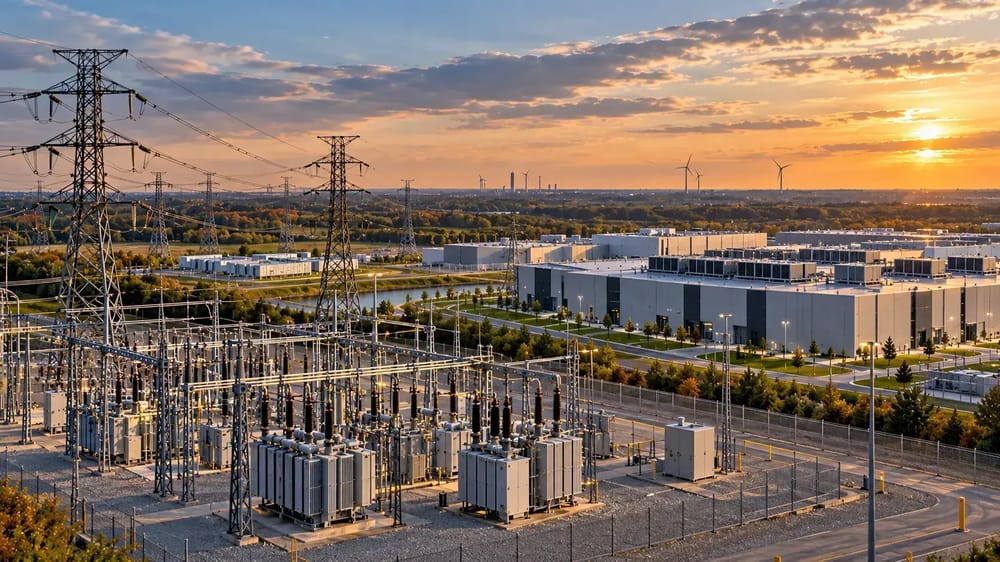
Electricity demand is becoming an increasingly important part of the artificial intelligence story. As data centers expand to support AI computing, cloud services, and digital infrastructure, utility companies face new opportunities to supply power while managing the cost of building and maintaining the grid.
DTE Energy (NYSE: DTE) is one company at the center of this changing landscape. Based in Detroit, Michigan, DTE operates electric and natural gas utilities alongside other energy-related businesses. Its plans to support large data-center developments have brought additional attention to its infrastructure investment strategy and longer-term business outlook.
However, rising electricity demand does not automatically translate into higher profits or a rising share price. Data-center projects require substantial infrastructure, regulatory approvals, customer agreements, and careful financial management. Investors must also consider DTE's existing utility operations, earnings performance, valuation, and capital requirements.
Recent WallStreetBets discussions provide another perspective on the stock, with options-related keywords appearing prominently in the available sentiment data. These conversations offer a snapshot of retail-trader attention, but they cannot replace financial analysis.
This article examines DTE Energy's stock through the lens of data-center demand, utility investment, market trends, company fundamentals, and the risks that could influence its future performance.
What Is DTE Energy (DTE)?
DTE Energy is a diversified energy company headquartered in Detroit, Michigan. Its electric utility serves approximately 2.3 million customers in southeastern Michigan, while its natural gas utility serves approximately 1.4 million customers across the state.
The company also has businesses focused on renewable energy generation, custom energy solutions, and energy marketing and trading.
This business mix is important because DTE's financial performance does not depend on a single source of revenue. Regulated utility operations are influenced by approved rates, customer demand, operating expenses, and infrastructure spending. Other energy businesses can introduce different growth opportunities and earnings variability.
The electric utility is particularly relevant to the data-center trend. Large computing facilities require significant amounts of electricity, dependable grid connections, and supporting infrastructure. Utilities serving these facilities may need to expand capacity and upgrade their systems to meet additional demand.
For DTE, the challenge is to accommodate new customers while maintaining reliability, managing costs, and meeting its obligations to existing residential and commercial customers.
Why Data Centers Matter to DTE Energy
Data centers are facilities that house computing equipment, networking systems, storage infrastructure, and supporting power and cooling systems. AI-focused facilities can require substantial electricity because of the computing workloads they support.
As demand for AI services expands, large technology companies are seeking access to more computing capacity. That creates an associated need for electricity generation, transmission, distribution infrastructure, and reliable power delivery.
DTE's service territory in Michigan has become part of this broader development.
In its public announcements, DTE has discussed large proposed data-center projects, including a 1.4-gigawatt project in Saline Township and a separate 1.0-gigawatt project in Van Buren Township. The projects have different development and approval statuses, so they should not be treated as identical or fully operational.
The company has also described a broader pipeline of potential data-center demand. In August 2026, industry reporting said DTE had 2.4 gigawatts of executed agreements with data-center customers, approximately 2 gigawatts in advanced discussions, and an additional pipeline of 3–4 gigawatts.
These figures help illustrate the scale of potential demand being discussed, but they require careful interpretation. Executed agreements, projects under regulatory review, advanced negotiations, and early-stage opportunities represent different levels of certainty.
They should not be combined into a single figure representing secured future revenue.
For investors, the important question is whether these projects progress from agreements and proposals into operating facilities that generate sustainable returns for the utility.
How Data-Center Demand Could Affect DTE's Growth
Additional electricity demand can create opportunities for utility companies to invest in their infrastructure and serve new customers.
If a data-center project proceeds as planned, the utility may need to construct or upgrade substations, transmission connections, distribution equipment, and other facilities. The customer agreements and applicable regulatory framework determine how those costs are allocated and how the utility can recover its investment.
DTE has stated that its data-center customers will be required to cover the additional infrastructure costs needed to serve them. The company has also described plans to pause future electric rate requests for at least two years after its upcoming filing, subject to conditions including the first supported data-center project coming online as planned and receiving other regulatory approvals.
These statements are important to the company's public position on customer affordability. However, they are not a guarantee that every project will proceed on schedule or that all financial and regulatory questions have been resolved.
The economic outcome depends on several factors:
- Whether projects receive the necessary approvals and reach completion.
- Whether customers fulfill their contractual commitments.
- How infrastructure costs, financing, and operating expenses are managed.
- Whether the utility earns an appropriate return on its investment.
- Whether additional demand can be accommodated without compromising grid reliability.
A growing data-center pipeline can create a meaningful opportunity, but the financial benefits depend on execution rather than announced capacity alone.
Data Centers, Electricity Bills, and Regulatory Challenges
The expansion of large computing facilities also raises questions about electricity affordability.
Building infrastructure to serve data centers can require significant investment. Regulators, utilities, customers, and policymakers must consider who pays for that investment, how costs are recovered, and whether existing customers are adequately protected.
DTE has said that its data-center customers will cover the costs associated with serving them and that its agreements include additional customer protections.
At the same time, DTE's conditional plans regarding future rate requests have attracted scrutiny. In April 2026, Planet Detroit reported on objections to the conditions associated with DTE's proposed rate-request pause, including concerns raised by Michigan's attorney general about the Saline Township data-center arrangements.
This disagreement highlights an important distinction between a company's stated commitments and the regulatory process governing its operations.
For stock analysis, regulatory developments matter because they can influence project timelines, cost recovery, customer rates, and the economics of new infrastructure. A favorable outcome for one project cannot automatically be assumed for every future development.
Data-center growth may support utility investment, but the details of each agreement and its regulatory treatment remain essential.
DTE Energy Stock Price and Recent Market Trends
DTE Energy shares closed at $129.73 on October 16, 2026, according to CompaniesMarketCap's market data. MarketWatch reported that the stock gained 1.09% during the session, marking its second consecutive day of gains.
The recovery came after a weaker period for the stock. The same market report placed DTE approximately 16.7% below its 52-week high of $155.75, reached on July 7, 2026.
This creates a mixed picture rather than a clear directional signal.
A two-day recovery can indicate renewed short-term buying interest, but it does not establish that a sustained upward trend has begun. Likewise, a share price below its previous high does not automatically mean the stock is undervalued.
The broader trend, trading volume, moving averages, and subsequent price action all matter when interpreting recent performance.
Historical market snapshots available for the period also showed a positive short-term return alongside a negative three-month return. These measures should be checked against a consistent price-data source before publication because calculations can differ by date and methodology.
For a balanced assessment, the recent recovery should be described as a short-term development within a broader period of weakness, not as confirmation of a reversal.
DTE Energy Market Capitalization and Valuation
CompaniesMarketCap reported DTE Energy's market capitalization at approximately $26.99 billion in October 2026. Market capitalization represents the total market value of a company's outstanding shares.
The website also provides historical market-capitalization data, which can help readers understand how the market has valued DTE over time.
Valuation ratios offer another perspective. The trailing price-to-earnings ratio compares the share price with earnings over the preceding 12 months, while the forward P/E uses estimated future earnings.
These measures are useful when comparing DTE with other regulated utilities, but they do not tell the complete story. Companies can trade at different multiples because of differences in expected earnings growth, debt, business mix, capital expenditure, and regulatory conditions.
A lower forward P/E may reflect expectations of earnings growth, but it can also reflect uncertainty or risks that the market believes deserve a discount.
Dividend yield should be evaluated with similar care. The indicated yield changes as the share price or expected dividend changes, and it does not independently establish whether a stock is attractively valued.
When comparing DTE with peers, investors should use valuation figures from the same date and verify whether the ratios use trailing or forecast earnings. That makes the comparison more meaningful than combining figures collected at different times.
The available valuation data offers context for analyzing DTE, but it does not establish that the shares are definitively undervalued or overvalued.
DTE Energy Earnings and Financial Performance
DTE's second-quarter 2026 results provide a useful foundation for evaluating the business behind the stock.
The company reported GAAP earnings of $282 million, or $1.35 per diluted share. Operating earnings were $274 million, or $1.32 per diluted share.
DTE also reaffirmed its full-year 2026 operating earnings guidance of $7.59 to $7.73 per diluted share in its second-quarter earnings release.
One important detail was the difference between GAAP and operating earnings. GAAP earnings increased from $229 million in the second quarter of 2025 to $282 million in the second quarter of 2026, while operating earnings declined from $283 million to $274 million.
Stronger energy-trading results helped offset weaker performance in the electric and natural gas utility businesses.
This shows why headline earnings growth should not be interpreted in isolation. A company can report higher GAAP earnings even when operating performance in parts of its core business weakens.
Investors should examine the sources of earnings, the sustainability of trading contributions, utility operating results, and management's explanation of the factors affecting future performance.
DTE's third-quarter 2026 earnings release is scheduled for November 5, 2026, before the market opens. The results should provide an opportunity to assess progress against management's guidance and review updates on infrastructure spending, customer demand, and the company's outlook.
What DTE's WallStreetBets Sentiment Reveals
Reddit discussions can help illustrate what retail traders are talking about, but they should be separated from the company's operating and financial performance.
In the supplied ApeWisdom screenshot, DTE recorded 71 mentions, 2,439 upvotes, and 69 mentioning users over the displayed 24-hour period. The screenshot showed positive WallStreetBets sentiment of 58%.
These figures describe the snapshot captured at that time. They are not permanent values, and later readings can differ as new posts appear and the tracking period changes.
The sentiment score suggests that positive comments represented a modest majority of the sampled discussion. It does not indicate that 58% of all investors are bullish, nor does it measure the amount of money entering or leaving the stock.
The nearby WSB keywords provide more detail about the topics being discussed.
Understanding the DTE WSB Keywords
The supplied keyword list includes:
- Options: 7 mentions
- Calls: 5
- Friday: 4
- Bought: 4
- SPY: 3
- Puts: 3
- SPX: 3
- More: 3
- Buy: 3
- Had, again, down, only, guys, and call: 2 each
Options, calls, and puts: These words indicate options-related discussion. Calls can be used for bullish exposure or other strategies, while puts can be used for bearish exposure or hedging. The keyword counts do not reveal whether contracts were bought or sold, their strike prices, expiration dates, or total traded volume.
Friday: This may refer to a trading session, an options expiration, or another event. Without the original posts, the precise meaning remains uncertain.
Bought and buy: These terms may indicate that users are discussing purchases or possible buying opportunities. They do not verify completed transactions or establish net buying pressure.
SPY and SPX: These terms refer to instruments associated with the broader U.S. equity market. Their presence suggests that some discussions may involve general market movements or index-related trading rather than DTE's fundamentals alone.
Down and again: These words may refer to recent price movements, repeated changes, or other context. Their low counts are insufficient evidence of a sustained decline.
Overall, the keywords suggest a meaningful short-term trading and options component to the available discussion. They do not establish a reliable prediction of DTE's share-price direction.
DTE's Infrastructure Investment and Energy Transition
Data-center demand is only one part of DTE's investment strategy.
The company reported investing more than $2.6 billion in its utility businesses during the first half of 2026. These investments support electric and natural gas infrastructure, reliability improvements, and cleaner energy initiatives.
DTE has also reported progress in renewable energy, including the completion of its 100-megawatt Cold Creek Solar Park.
Infrastructure investment can support future capacity and service reliability, but it also requires capital. Construction costs, project timelines, financing, regulatory treatment, and the ability to recover investment through permitted mechanisms all affect the eventual financial outcome.
The company's capital program should therefore be assessed in terms of both its potential benefits and the obligations it creates.
For shareholders, the key question is whether DTE can deliver the planned improvements while maintaining financial flexibility and generating appropriate returns over time.
Key Risks That Could Affect DTE Energy's Outlook
DTE's position in a growing electricity market does not eliminate the risks associated with operating a capital-intensive utility.
Financing Costs and Capital Requirements
Building and upgrading utility infrastructure requires substantial investment. Higher borrowing costs can increase interest expense and make it more difficult to finance new projects while maintaining financial flexibility.
Regulatory Uncertainty
Data-center contracts, customer-rate decisions, and infrastructure approvals can affect project timelines and cost recovery. Changes in regulatory outcomes may influence the economics of planned investments.
Data-Center Execution
Announced capacity is not equivalent to completed infrastructure or recognized revenue. Projects may be delayed, changed, or subject to additional conditions before they contribute to operating results.
Customer Affordability
Utilities must balance investment needs with reliable service and reasonable customer costs. Disputes over who pays for new infrastructure can create regulatory, political, and reputational challenges.
Earnings Variability
Energy-trading results and changes in utility operating performance can affect quarterly earnings. Strong results in one business may offset weakness in another, making segment-level analysis important.
Market Valuation
Even if DTE's long-term business prospects remain sound, changes in interest rates, investor expectations, and relative valuation can affect the share price.
These risks do not establish that DTE will underperform. They identify the issues that should be monitored alongside the company's growth opportunities.
What Investors May Watch Next
Several developments can help clarify how DTE's data-center strategy and overall business performance are progressing.
Third-quarter earnings: DTE's November 5, 2026, earnings report should provide updated results and management commentary.
Data-center project milestones: Regulatory approvals, construction progress, contractual arrangements, and service timelines can help distinguish potential demand from projects that are moving toward operation.
Infrastructure spending: Future disclosures can show how investment requirements compare with management's plans and the company's financial capacity.
Earnings guidance: Investors can assess whether DTE maintains or changes its full-year operating EPS guidance of 7.59–7.73.
Customer-rate developments: Regulatory decisions and the conditions associated with DTE's rate-request plans can influence the economics of future investment.
Market performance: Subsequent price movements, trading volume, and moving averages can help establish whether the recent recovery develops into a more sustained trend.
WSB sentiment: Changes in mentions and keywords may offer insight into retail attention, but they should remain secondary to company disclosures and actual market data.
Monitoring these indicators provides a more useful framework than relying on a single share-price move or social-media sentiment score.
DTE Energy (DTE) Stock Outlook
DTE Energy's market outlook is closely linked to the relationship between electricity demand, infrastructure investment, and the economics of serving new customers.
Data-center development could create opportunities for additional utility investment and electricity sales. However, the financial benefits depend on projects proceeding as planned, contractual obligations being fulfilled, and infrastructure costs being managed under the relevant regulatory framework.
The company's existing utility operations, earnings performance, capital requirements, dividend profile, and financing costs remain equally important to its longer-term position.
The recent share-price recovery provides a development to monitor, but the available October 2026 market snapshot showed a mixed technical picture. Similarly, the WSB keyword data indicates options-related discussion without providing a reliable directional signal.
A balanced assessment should therefore distinguish the scale of potential data-center demand from realized business results. It should also consider the risks associated with regulatory decisions, project execution, customer affordability, and capital spending.
Ultimately, DTE's longer-term performance will depend on its ability to serve growing electricity demand while maintaining reliable operations and translating investment into sustainable financial results.
Educational and informational disclaimer: This article is for educational and informational purposes only. It does not constitute investment advice or a recommendation to buy or sell any security.

Smarter Trading Starts With Clarity
A data-driven approach combining advanced AI, behavioral analytics, and institutional-grade insights to help investors make confident, informed decisions in any market condition.
© Copyright 2025 OVTLYR - All rights reserved.
5830 Granite Pkwy, Suite #100, Plano, TX 75024, USA
Contact now at support@ovtlyr.com