Tesla (TSLA) Stock Analysis: Roadster Buzz and Market Outlook
Friday, October 16, 2026
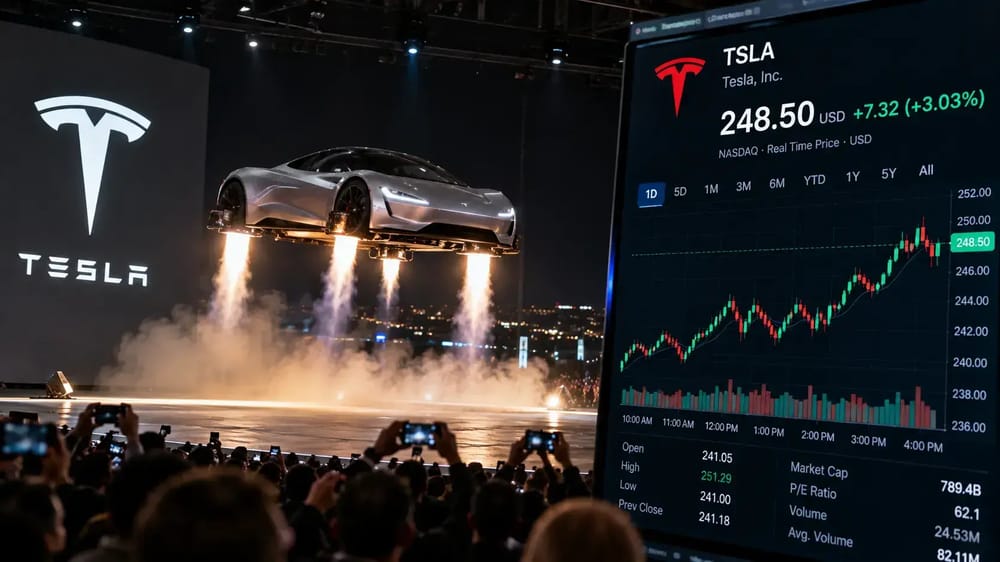
Tesla (NASDAQ: TSLA) continues to attract attention from retail traders, technology enthusiasts, and investors who follow developments in electric vehicles, artificial intelligence, and autonomous driving. Recent discussions have also brought the company's redesigned Roadster into focus, particularly after its October 2026 unveiling featured an unusual demonstration involving rocket-style thrusters and brief aerial maneuvers.
However, strong public interest does not automatically translate into sustainable stock performance. Understanding Tesla's market outlook requires looking beyond headlines and social media activity to examine investor expectations, business fundamentals, product execution, and the financial results that ultimately support a company's valuation.
This analysis reviews Tesla's recent WallStreetBets (WSB) discussion patterns, the meaning of its most prominent keywords, and the potential implications of the Roadster announcement for investors evaluating TSLA stock.
Tesla Stock Overview: What Is Driving Market Attention?
Tesla operates across electric vehicles, energy generation and storage, charging infrastructure, and technology initiatives involving autonomous driving and robotics. This combination makes the company different from a traditional automaker because investors often evaluate both its existing businesses and its potential future opportunities.
That broader narrative can influence how traders interpret company announcements. A product reveal may generate attention because of its engineering, while investors may separately assess whether the product can contribute meaningful revenue, improve margins, or strengthen the company's competitive position.
Tesla's redesigned Roadster has become a relevant example of this distinction. Its unusual demonstration has attracted attention, but the financial implications depend on factors such as production readiness, customer demand, delivery timing, and the economics of manufacturing the vehicle.
For TSLA stock, the central question is not simply whether a product attracts attention. It is whether the company's developments can translate into measurable commercial results.
Tesla's Flying Roadster: Innovation, Expectations, and Stock Sentiment
Tesla unveiled its redesigned second-generation Roadster on October 15, 2026. The demonstration featured a vehicle using SpaceX-assisted, rocket-style thrusters to perform brief aerial maneuvers, alongside a suction system that enables unusual movement on a specially designed surface.
The announcement has renewed discussion around the concept of flying cars. It is important, however, to distinguish the demonstrated Roadster concept from a conventional road vehicle that can operate as an independently certified aircraft. The aerial capabilities shown at the event do not establish that the vehicle can function as an everyday flying car.
Tesla has indicated a 2028 production timeline. Until the vehicle reaches production, important questions remain about final specifications, practical use, safety requirements, regulatory treatment, manufacturing costs, and customer deliveries.
Why the Roadster matters to Tesla's market narrative
The Roadster can influence how people perceive Tesla's engineering ambitions and its ability to develop distinctive products. A technically ambitious vehicle may strengthen brand visibility, attract new interest, and demonstrate engineering capabilities.
Those potential benefits should be separated from direct financial impact.
Investors need to consider whether the Roadster can generate meaningful sales, support attractive margins, or contribute to a broader business strategy. A high-profile demonstration alone does not establish any of these outcomes.
The production timeline also matters. Plans for 2028 leave room for changes in specifications, costs, and delivery schedules. Previous delays associated with the next-generation Roadster make execution an important consideration when assessing future expectations.
Consequently, the flying-car discussion is best understood as part of Tesla's innovation narrative rather than independent evidence that TSLA shares must rise.
Tesla WSB Sentiment: What Recent Reddit Activity Shows
The supplied ApeWisdom snapshot for Tesla showed the following activity over the preceding 24 hours:
| Metric | Reported figure |
|---|---|
| Mentions | 284 |
| Change in mentions | +847% |
| Upvotes | 16,098 |
| Change in upvotes | +21,654% |
| Mentioning users | 193 |
| Change in mentioning users | +642% |
| Overall positive sentiment | 65% |
| WSB positive sentiment | 65% |
These figures suggest a substantial increase in discussion compared with the previous comparison period shown on the page. The positive sentiment reading also indicates that the tracker classified a larger share of comments as positive than negative.
Nevertheless, social sentiment is not a direct measurement of buying pressure in the stock market. Reddit users may discuss a company because of product announcements, speculative possibilities, options positions, criticism, or disagreements about valuation.
Upvotes measure engagement within the platform, not purchases of TSLA shares. Similarly, an increase in mentions does not establish that institutional investors are accumulating stock or that a price rally will continue.
The figures should therefore be treated as a snapshot of online attention, not a standalone indicator of future returns.
Understanding the Most Prominent WSB Keywords
The Tesla WSB keyword data supplied for this analysis included:
- calls - 21
- spcx - 15
- puts - 15
- flying - 13
- stock - 11
- roadster - 10
- after - 10
- up - 10
- open - 9
- like - 9
- banbet - 8
- buy - 8
- target - 7
- move - 7
These keyword counts indicate which terms appeared frequently in the tracked discussions. Their meaning depends on the surrounding conversations, so they should not be interpreted as independent trading signals.
Calls and puts: Options-related discussion
The prominence of “calls” and “puts” indicates that options trading was a noticeable part of the conversation.
A call option generally gives its holder the right to buy shares at a specified strike price under the contract's terms. A put option generally gives its holder the right to sell shares at a specified strike price.
Neither term establishes a bullish or bearish market position on its own. Traders may buy or sell options, use spreads, hedge existing holdings, or discuss contracts without executing a trade.
The keyword counts also do not reveal contract expiration dates, strike prices, premiums, open interest, or whether the options were bought or sold. Those details are necessary to evaluate actual options positioning.
Flying and Roadster: The product narrative
The appearance of “flying” and “roadster” is particularly relevant following the October 15 announcement.
These terms suggest that the vehicle's unusual demonstration formed part of the tracked conversation. Traders may be discussing the technology, the event itself, its potential commercial value, or the broader implications for Tesla's brand.
The counts alone cannot establish which interpretation dominates. Nor can they determine whether the discussion reflects durable investor interest or a short-lived response to a headline.
SPCX: Verify the context before interpreting the term
The keyword “spcx” requires particular care. A keyword tracker does not explain whether users are referring to SpaceX, using shorthand, or discussing something else.
Given the reported collaboration between Tesla and SpaceX engineers on the Roadster demonstration, a connection to SpaceX is plausible. However, the keyword should not be treated as proof of a merger, a corporate transaction, or a change in ownership.
Any such interpretation would require separate confirmation from reliable reporting or official company disclosures.
Up, buy, target, and move
Terms such as “up,” “buy,” “target,” and “move” commonly appear in trading discussions. Their presence does not establish a consensus forecast.
For example, “buy” might appear in a bullish argument, a question about an entry point, or a comment disagreeing with another trader. “Target” may refer to a price objective or a broader discussion of expectations.
The surrounding post is essential to determining what the writer actually meant.
Banbet: A community prediction, not a market indicator
“Banbet” generally refers to a community prediction challenge in which users stake their posting privileges on a forecast. Its presence may indicate speculative engagement, but it is not a verified record of institutional positioning or a reliable measure of future stock direction.
What the Roadster Announcement Could Mean for TSLA Stock
There are several ways the Roadster announcement could influence how investors evaluate Tesla.
1. Brand visibility and technological differentiation
A distinctive product demonstration can attract media coverage and reinforce the perception that a company is pursuing ambitious engineering projects.
For Tesla, the Roadster may contribute to a technology-focused brand narrative that extends beyond conventional electric vehicles.
The financial benefit, if any, depends on whether that attention translates into customer demand, pricing power, or other measurable commercial advantages.
2. Production execution and delivery expectations
A planned production date is not the same as completed production. Investors should distinguish between demonstrations, prototypes, final specifications, manufacturing readiness, and vehicles delivered to customers.
Production delays, unexpected costs, or changes in product capabilities could affect expectations. Successful execution would provide stronger evidence of commercial progress than a presentation alone.
3. Revenue, margins, and cash flow
The Roadster's commercial significance depends on its eventual sales volume, pricing, production costs, and profitability.
A premium vehicle can attract attention without becoming a major contributor to company-wide revenue. Conversely, a product with relatively limited volume may still have strategic value if it supports other business objectives.
Investors should assess actual financial disclosures rather than assume that an eye-catching product will materially improve Tesla's earnings.
4. Autonomous driving, AI, and the wider business strategy
Tesla's longer-term narrative includes autonomous driving, robotaxi services, robotics, and AI-related technology.
These opportunities may influence valuation expectations, but they also involve technical, operational, regulatory, and commercial uncertainties.
The Roadster announcement should be evaluated within that wider business context rather than treated as a substitute for progress in Tesla's core operations.
Bullish and Bearish Considerations for Tesla Investors
A balanced analysis considers both the potential opportunities and the risks.
Potentially supportive factors
- Strong attention surrounding a distinctive product announcement.
- The potential for the Roadster to reinforce Tesla's engineering and technology brand.
- Continued investor interest in autonomous driving, AI, robotics, and energy storage.
- The possibility that successful execution of future products could support longer-term business growth.
- A high level of retail discussion that may keep Tesla on traders' radar.
These factors describe potential sources of interest. They do not establish that the stock is undervalued or likely to rise.
Important risks and uncertainties
- Production timing and commercial availability may differ from current expectations.
- Development and manufacturing costs could affect profitability.
- Social media sentiment may change rapidly after a news-driven spike.
- Options activity can reflect hedging and speculative strategies, not just directional conviction.
- Expectations for future technology may already be reflected in the stock's valuation.
- Competition, vehicle demand, pricing, margins, and regulatory developments remain relevant to Tesla's business.
The balance between these factors depends on Tesla's actual financial performance, market valuation, and subsequent company disclosures.
Bullish and Bearish Considerations for Tesla Investors
Investors examining TSLA can use a structured process rather than relying on individual keywords or headline reactions.
First, review the company's financial results. Revenue growth, operating margins, earnings, cash flow, capital expenditure, and inventory trends can help establish whether business performance supports market expectations.
Second, separate confirmed developments from future plans. A product demonstration, a stated production target, and completed customer deliveries represent different stages of execution.
Third, examine price and volume data. Actual price movements, trading volume, volatility, and relevant technical levels provide information that social media counts cannot supply. Technical indicators should still be interpreted alongside broader market conditions.
Fourth, assess options data directly. Strike prices, expiration dates, volume, open interest, and implied volatility are more informative than simply counting mentions of “calls” and “puts.”
Finally, compare expectations with evidence. When a stock attracts attention because of a major announcement, it is useful to ask what the market already expects and what new information would justify changing those expectations.
This approach helps distinguish a compelling product narrative from evidence of improving business fundamentals.
Tesla (TSLA) Market Outlook: What to Watch Next
Tesla's near-term outlook depends on how investors interpret recent product developments alongside the company's financial performance and wider strategic direction.
The Roadster announcement has introduced an unusual technology story into the Tesla discussion. Its aerial demonstration and SpaceX-assisted features may continue to attract attention, but production remains planned for 2028, leaving significant execution questions to be resolved.
The next important developments include updates to the Roadster's production schedule and specifications, Tesla's financial results, vehicle demand, profitability, and progress in autonomous driving and other technology initiatives.
The supplied WSB data also shows that online discussion was elevated during the measured period. Whether that attention persists is a separate question from whether the company's business performance improves.
A useful market outlook therefore considers three distinct elements: social sentiment, observable market activity, and company fundamentals. None should be used as a substitute for the others.
Conclusion
Tesla's latest Roadster reveal provides an interesting case study in how technology announcements can influence investor attention and online trading discussions. The appearance of “flying” and “roadster” among the tracked WSB keywords is consistent with interest in the vehicle's unusual demonstration.
However, high mention counts, positive sentiment, and options-related discussion do not establish a reliable direction for TSLA stock. The Roadster's eventual financial contribution will depend on execution, production, customer demand, and commercial results.
For readers evaluating Tesla, the most useful approach is to treat social sentiment as context, verify product claims and timelines, and assess financial and market data independently.
Educational Disclaimer: This article is for educational and informational purposes only. It does not constitute investment advice or a recommendation to buy or sell any security. Social media metrics are time-sensitive and reflect the supplied ApeWisdom snapshot, not necessarily current conditions. Investors should verify the latest company disclosures, market data, and relevant risks before making financial decisions.

Smarter Trading Starts With Clarity
A data-driven approach combining advanced AI, behavioral analytics, and institutional-grade insights to help investors make confident, informed decisions in any market condition.
© Copyright 2025 OVTLYR - All rights reserved.
5830 Granite Pkwy, Suite #100, Plano, TX 75024, USA
Contact now at support@ovtlyr.com